Coaching Youth Baseball and the 2 Inning Infield Requirement
How a youth baseball coach met a 2-inning infield rule without losing his mind — using Plays Manager to build a fair rotation and print lineup and position sheets so the dugout could run itself.
Last updated September 10, 2026 · Coach Kelly
The rule that changes everything
Youth baseball leagues are adding more player-development rules, and one of the toughest is the infield minimum. In our league, every kid must play at least two innings in the infield every game.
That sounds simple until you are also trying to win, keep parents happy, and remember who played where while a 10U runner is stealing second.
The paper problem
I used to draw the lineup on a clipboard in the dugout. I would count innings in my head, move kids around between innings, and hope I did not accidentally stick the same three kids in the outfield for four innings.
The clipboard worked until someone got sick, a substitute showed up, or I got wrapped up in a close play and forgot to update my tally. Then I would spend the last inning scrambling to find a kid who still needed an infield inning while the bases were loaded.
Setting the rotation
Plays Manager has a baseball/softball planner that lets you set a minimum number of infield innings per player. I built our roster once, set the infield minimum to 2, and let the planner fill the field inning by inning.
It tracks who has been in the infield and who still needs time there, so I do not have to keep a separate tally.
- Pitcher, catcher, first, second, third and shortstop count as infield innings.
- Left, center and right field do not.
- Injured or absent players stay off the tally automatically.
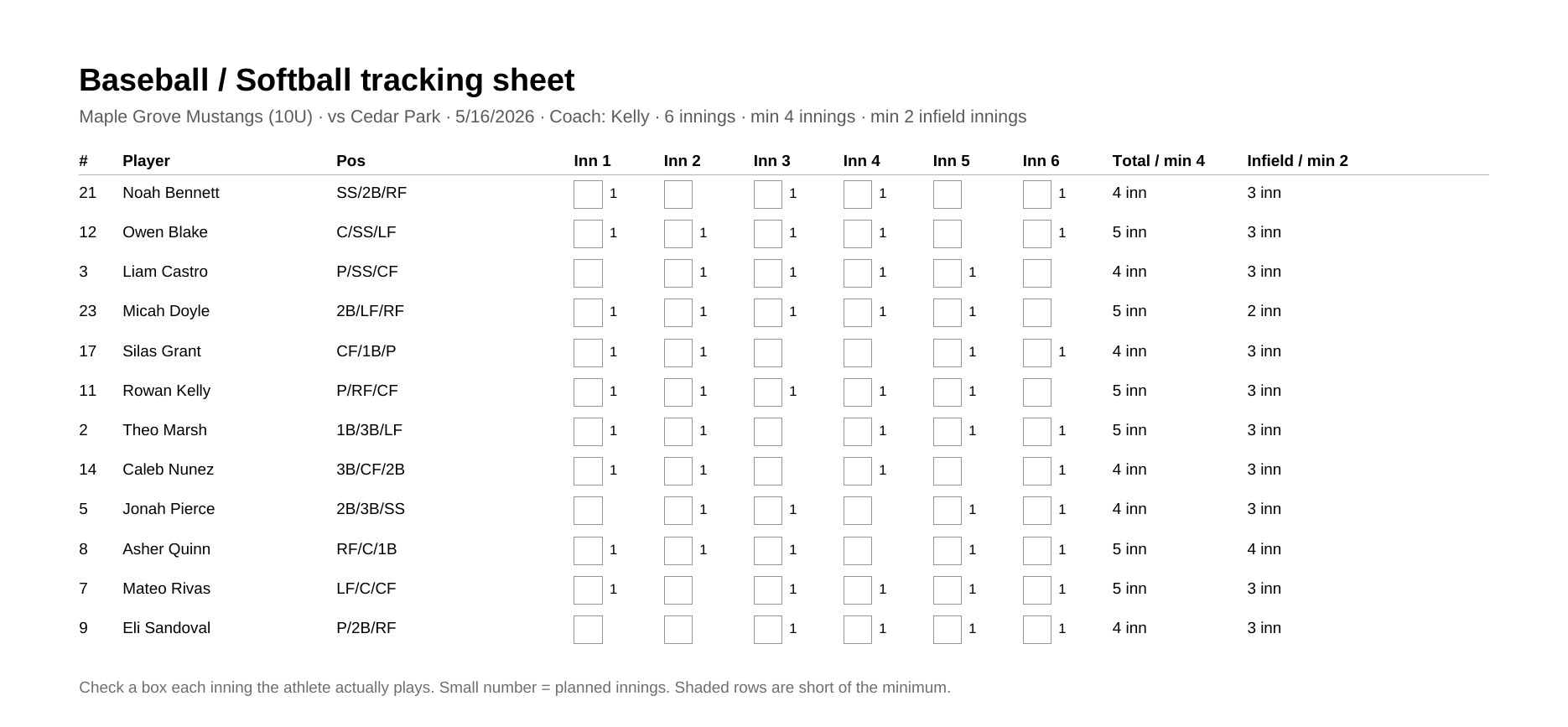
When a last-minute sub arrived, I added him to the roster, hit Suggest, and the planner reworked the rotations to keep the infield rule intact without burying anyone on the bench.
The sheets that run the dugout
The best part is printing. I print the lineup card for the dugout fence and the position page for the assistant coaches.
- The lineup card shows the batting order, defensive positions by inning, and bench assignments.
- The position page gives each kid a visual view of where he plays each inning.
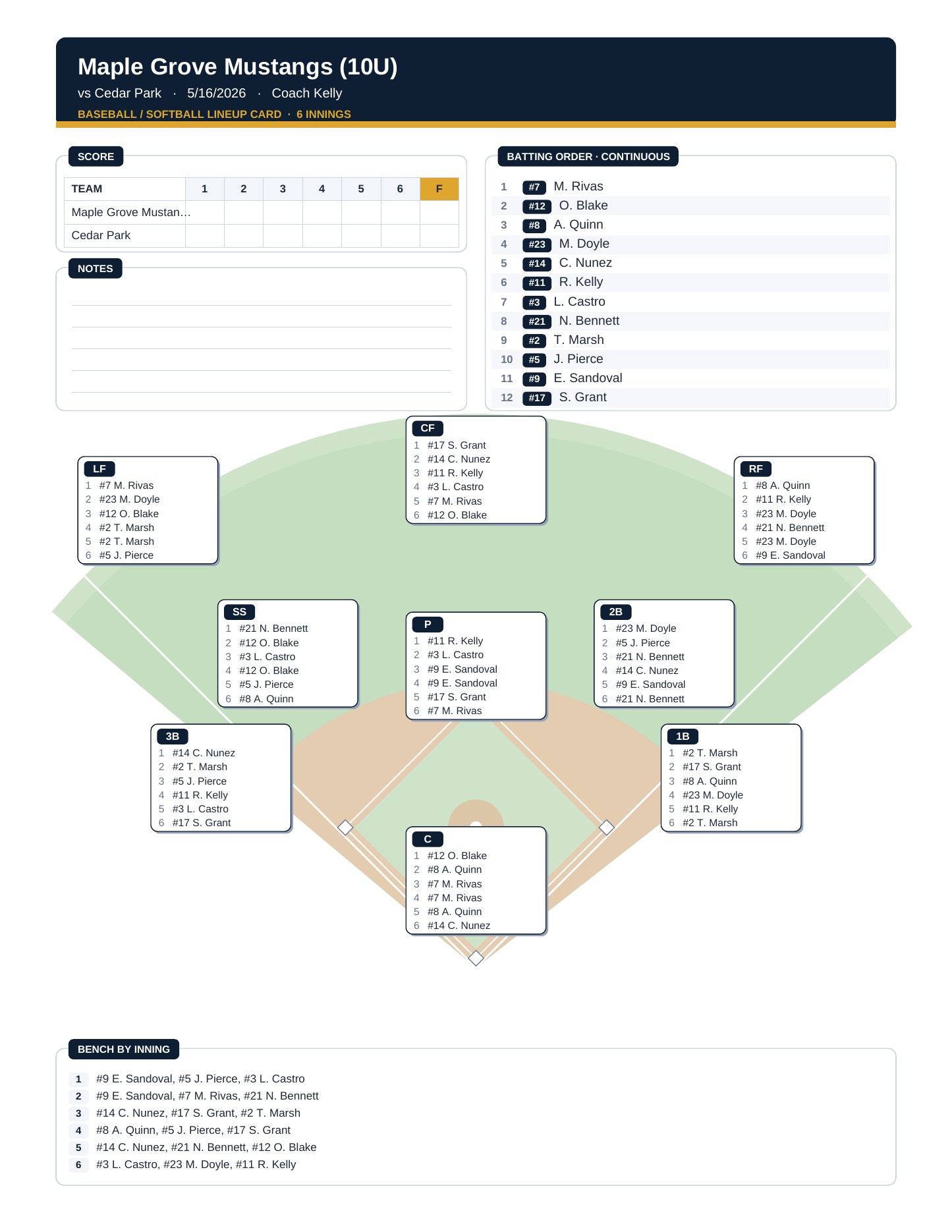
Instead of me shouting positions across the dugout, the kids grab the sheet, find their name, and line up. Assistant coaches can point to the next inning while I am talking to the pitcher. It turns the dugout from chaos into a little self-serve operation.
What game day felt like
Last Saturday I coached the whole game without once asking, "Has Tommy played first base yet?" I knew the rotation was fair before the first pitch. The kids moved themselves because the sheet told them where to go. I spent my time coaching base running and pitch calls instead of counting innings.
Parents noticed too. No one asked why their son was only in the outfield. The printed plan made the fairness visible.
Try it for your team
If your league has an infield minimum, or you just want every kid to get a fair look at the infield, set up a baseball or softball plan in Plays Manager.
- Build your roster once.
- Set the infield minimum.
- Print the lineup card and position page.
- Coach the game instead of managing the clipboard.
Start a free trial and see how the first plan looks for your team.
Try it for your team
Plays Manager plans your rotation before kickoff so every kid gets their minutes.